The short answer
- A U-value is the heat lost in watts per square metre for each degree of temperature difference (W/m²K). The lower the number, the better the insulation.
- Published figures: polycarbonate 1.2 to 2.8 depending on thickness, a standard double glazed unit 2.8, performance glass 1.0 to 1.2, insulated panels 0.29 at the centre and tiled warm roofs 0.12 to 0.18.
- The building regulations limit for a new roof in an existing home is 0.15 in England, 0.13 in Wales and 0.12 in Scotland.
- Summer heat depends on the g-value, the share of the sun's heat let through, not the U-value. A solid roof lets almost none through except via roof windows.
- Panel figures are usually quoted at the centre of the panel. Glazing bars and the ridge lose heat faster, so the whole roof does worse.
What is a U-value?
A U-value measures how much heat passes through one square metre of a building element for every degree of difference between the temperatures on each side, in watts per square metre per kelvin (W/m²K). Lower means better insulated. Halve the U-value and, all else equal, you halve the heat lost through that roof.
The sum behind it is simple: heat lost in watts equals the U-value, times the area, times the temperature difference. That is why the roof matters so much in a conservatory. It is usually the largest surface, and on a glass or polycarbonate roof it has a high U-value.
A U-value only describes heat escaping. How hot the room gets in the sun depends on a different number, the g-value or solar transmission, covered further down.
Conservatory roof U-values compared
These are the published figures for each type of roof. All come from makers, retailers or installers. We found no independent tests that compare them side by side.
| Roof | U-value (W/m²K) | Sun’s heat let through | Source |
|---|---|---|---|
| 10mm twin-wall polycarbonate | 2.8 | Not given | WholesalePOS (retailer) |
| 16mm polycarbonate | 1.9 to 2.4 | Not given | WholesalePOS; Superior Conservatory Panels |
| 25mm polycarbonate | 1.5 to 1.7 | 63% clear, 37% opal, 26% bronze, 8% Solarguard | WholesalePOS; Ultraframe |
| 35mm polycarbonate | 1.2 to 1.3 | 55% clear, 35% opal, 14% bronze, 8% Solarguard | WholesalePOS; Ultraframe |
| Standard double glazed unit | 2.8 | 75% | Ultraframe |
| Performance glass (standard range) | 1.2 | 24% to 70%, depending on tint | Ultraframe |
| Performance glass (top grade) | 1.0 | 18% to 45% | Ultraframe |
| Insulated aluminium panels | 0.29 at the centre of the panel | None | Thermotec, Superior, Green Space |
| Tiled warm roof | 0.12 to 0.18 | None, except through roof windows | Guardian, Ultraframe and others |
What is the U-value of a polycarbonate conservatory roof?
Between about 1.2 and 2.8 W/m²K, depending mostly on thickness. Published figures give 2.8 for 10mm twin-wall sheet, 1.9 to 2.4 for 16mm, 1.5 to 1.7 for 25mm and 1.2 to 1.3 for 35mm. That is eight to nineteen times the heat loss of a roof built to England’s 0.15 limit.
Makers disagree slightly for the same thickness, which is why the table gives ranges. The tint (clear, opal, bronze or a solar control grade) changes how much sun gets in, not the U-value. One retailer says 10mm twin-wall sheet on its own does not reach a 2.0 W/m²K roof figure. If you are re-sheeting, our guide to polycarbonate thickness compares the common sizes.
What is the U-value of a glass conservatory roof?
It depends on the glass. Ultraframe gives 2.8 W/m²K for a standard double glazed unit, 1.2 for its standard performance glass and 1.0 for its top grade. For energy ratings, a double glazed conservatory roof that is open to the house is given a default U-value of 3.4.
That spread matters. A modern performance glass roof loses less than half the heat of a standard sealed unit, and much less than thin polycarbonate. It is still far behind a solid roof. The tint and coatings also change how much sun gets in, which is often the bigger problem. Our guide to solar control glass explains how to choose.
What U-value do tiled and warm roofs achieve?
Makers quote 0.12 to 0.18 W/m²K. Guardian says its roof achieves 0.15 in England, 0.13 in Wales and 0.12 in Scotland, and Ultraframe quotes 0.15 as standard for LivinRoof with a 0.12 option. Older pages and certificates quoting 0.18 do not meet today’s English limit, so ask for your roof’s calculation.
| System | Stated U-value (W/m²K) | Note |
|---|---|---|
| Guardian Warm Roof | 0.15 England, 0.13 Wales, 0.12 Scotland | “Independently tested by” BRE, per Guardian. An older brochure said a maximum of 0.18. |
| Ultraframe LivinRoof | 0.15 standard, 0.12 option | The copy of its LABC certificate online shows 0.18 and a validity date of 2022. |
| SupaLite | 0.15 | Stated by an installer of the system |
| Eurocell Equinox | 0.18 | Reported by ExpertSure |
| Leka | Not published | Leka claims an “industry leading U Value” without a figure |
Our guide to warm roofs explains how these roofs are built.
What U-value does a new conservatory roof need?
In England a new solid roof must reach 0.15 W/m²K, the Approved Document L limit for a new roof in an existing home. Wales asks for 0.13, Scotland 0.12 and Northern Ireland 0.16 to 0.18. A like-for-like glazed roof on an exempt conservatory has no U-value target, because the energy rules do not apply.
| Element | England | Wales | Scotland |
|---|---|---|---|
| New roof | 0.15 | 0.13 | 0.12 |
| Roof window | 1.4 or Window Energy Rating Band B | 1.4 or Band B | 1.4 |
| Rooflight | 2.2 | 2.2 | 2.1 |
England’s 2026 edition of Approved Document L, in force from 24 March 2027, keeps the same roof figure. Northern Ireland’s Technical Booklet F1 sets 0.16 to 0.18 depending on where the insulation sits, and 1.6 (or Band C) for roof windows and rooflights. Our building regulations guide explains when these limits apply.
Why the quoted figure can flatter the roof
A single U-value on a brochure rarely describes the whole roof. Watch for four things:
- Centre-of-panel figures. Insulated panels are usually quoted at their thickest point. Bryant & Cairns, which sells solid roofs, argues that heat is still lost through the bars and ridge of the existing roof, and that aluminium skins without thermal breaks risk cold bridging and condensation. If you are weighing up insulated panels, ask for a whole-roof figure.
- Fixings and steel. LABC asks inspectors to check that screw fixings are not creating cold bridges, and says steel profiles should be modelled to BS EN 10211.
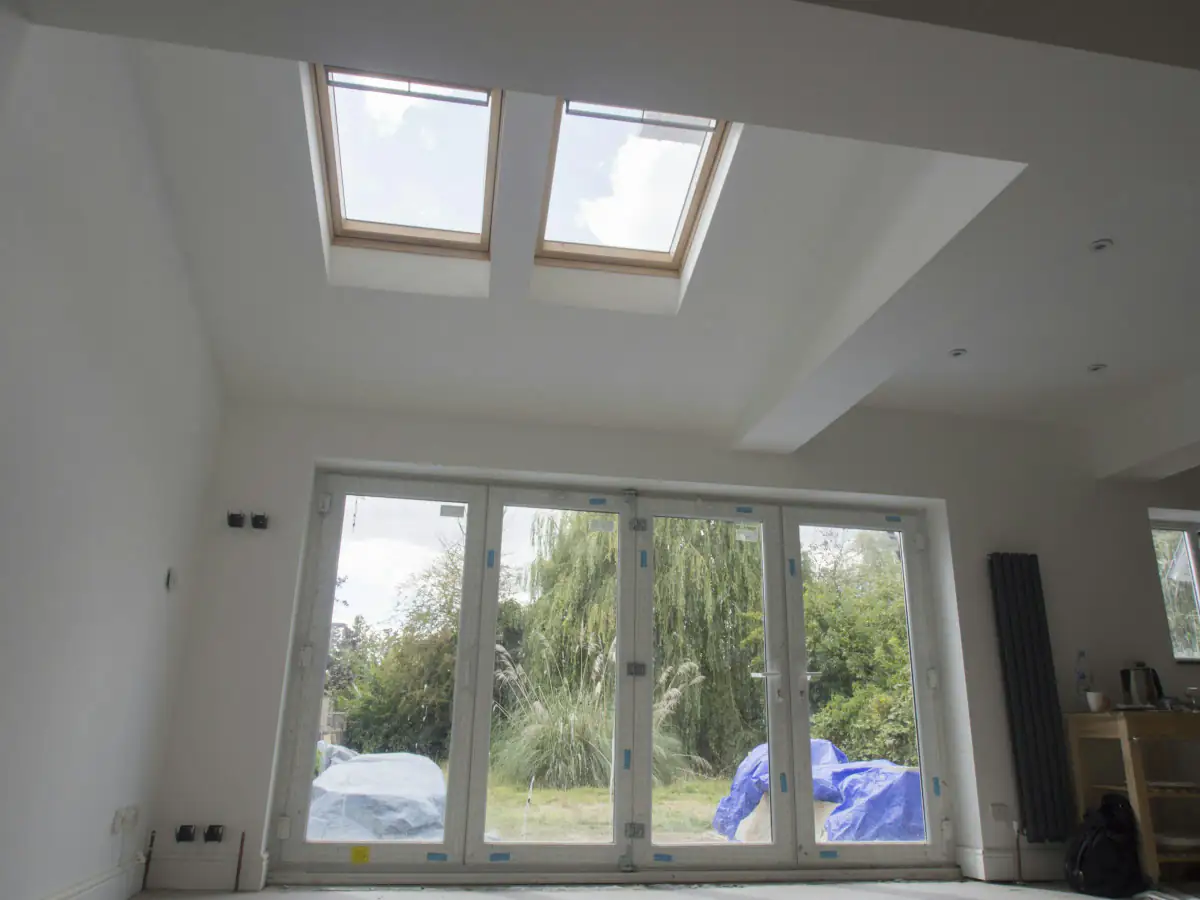
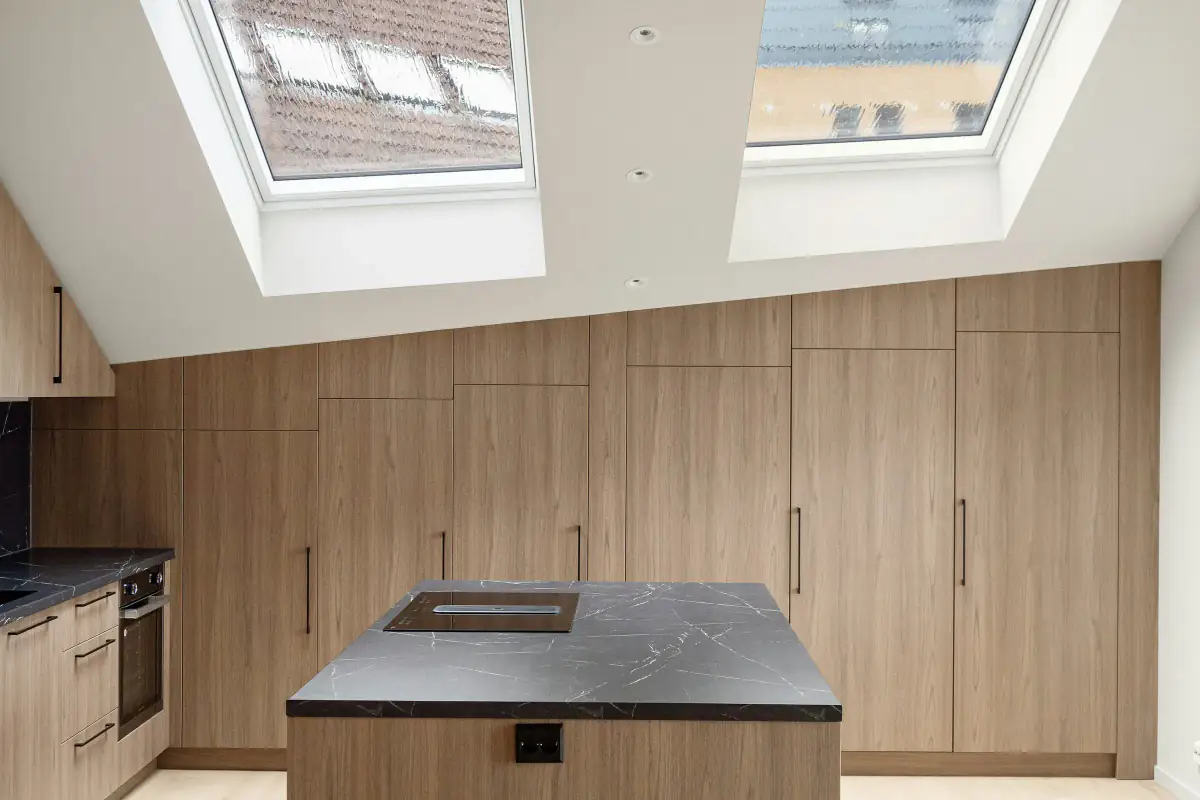
- Roof windows and glazed panels. Every window or panel in a solid roof has a much higher U-value than the insulated area around it, so a hybrid roof performs somewhere between tiled and glass.
- The rest of the room. Walls, windows, doors and the floor still lose heat. A 0.15 roof on an uninsulated dwarf wall and old frames will not feel like a room in the house.
What the numbers mean in practice
To see the scale, take a roof of 14 square metres with the room at 20°C and 5°C outside, a 15 degree difference. Using heat lost = U-value x area x temperature difference:
| Roof | U-value | Heat lost through the roof |
|---|---|---|
| 25mm polycarbonate | 1.7 | about 360 watts |
| Performance glass | 1.0 | about 210 watts |
| Insulated panels (centre figure) | 0.29 | about 60 watts |
| Tiled warm roof | 0.15 | about 30 watts |
This is an illustration of the roof alone. It ignores walls, windows, floor and draughts, and a pitched roof has more surface area than the floor beneath it.
U-value versus g-value in summer
In summer the problem is heat getting in, not heat getting out. That is measured by the g-value (for glass) or solar transmission (for polycarbonate): the share of the sun’s heat that passes through. A standard double glazed unit lets through about 75%, performance glass 18% to 70%, and clear 25mm polycarbonate about 63%. A solid roof lets almost none through.
Ultraframe advises high light, low solar rejection glass for rooms facing north or east, and low light, high solar rejection glass for rooms facing south or west. If overheating is your main complaint, see our guide to a conservatory that is too hot.
Does a lower U-value mean lower bills?
Only if you heat the room. A lower U-value cuts heat loss, but a conservatory separated from the house and left unheated will not show that on your bills; you feel it as comfort. We found no independent evidence of bill savings from a new conservatory roof.
Most conservatories are heated at least some of the time: BRE found about 77% had some form of heating. The savings figures that exist come from manufacturers, such as Guardian’s “more than £200 per year”, based on modelling that assumed electric heating. Our guide on whether a new roof cuts heating bills looks at them in detail.
An energy rating ignores a conservatory separated from the house. Once a solid roof goes on, the rules used since August 2026 record it as an extension, and its insulation as “none” unless there is visual or documentary evidence. So keep the specification.
When you get quotes for a tiled roof or any other roof, ask each installer for the U-value calculation for your roof in writing, not a brochure figure. Building control will want it, and so will an energy assessor.
Questions people ask
What U-value does a Guardian Warm Roof achieve?
Guardian's current FAQ gives BRE-tested U-values of 0.15 W/m²K in England, 0.13 in Wales and 0.12 in Scotland. Some installer and review pages still quote 0.18, which may reflect an older specification, so ask for the calculation for your roof.
Is a U-value of 0.18 good enough for a new conservatory roof?
Not in England, Wales or Scotland for a new solid roof. Approved Document L sets 0.15 W/m²K for a new roof in an existing English home, and Wales and Scotland are tighter still. Northern Ireland's booklet allows 0.16 to 0.18 depending on how the roof is built.
How much better insulated is a solid roof than glass?
On published figures, a solid roof at 0.15 W/m²K loses about a seventh of the heat of performance glass at 1.0, and around a nineteenth of a standard double glazed unit at 2.8. The Eco Experts describes solid roofs as around 15 times more thermally efficient than old glass or polycarbonate roofs.
Do roof windows affect the U-value of a solid roof?
Yes. In England a new roof window only has to reach 1.4 W/m²K and a rooflight 2.2, against 0.15 for the solid roof around it, so each one adds to the roof's overall heat loss. The effect depends on how many you fit and how big they are.
What U-value do insulated roof panels achieve?
Panel makers such as Thermotec, Superior Conservatory Panels and Green Space quote 0.29 W/m²K, usually for 75mm panels measured at the centre. The glazing bars and ridge of the old roof stay in place and lose heat faster, so the whole roof performs worse than that figure.
Sources
- Approved Document L, Volume 1: Dwellings (2021 edition incorporating 2023 amendments)
- Approved Document L, Volume 1 (2026 edition)
- Welsh Approved Document L, Volume 1 (2022 incorporating 2024 amendments)
- Scottish Building Standards Technical Handbook, Domestic (April 2026)
- Northern Ireland Technical Booklet F1:2022
- Ultraframe glass roof technical guide
- WholesalePOS: polycarbonate roofing sheets guide 2026
- Superior Conservatory Panels: polycarbonate vs aluminium roof
- Door and Window Experts: Thermotec roof panels review
- Green Space: can I put a solid roof on my conservatory?
- Guardian Building Systems: FAQ
- Ultraframe: LivinRoof
- Ultraframe LivinRoof LABC Registered Detail certificate
- ExpertSure: Equinox roof review
- Bryant & Cairns: aluminium insulated roof panels, the pitfalls
- LABC guidance on solid roofs to conservatories (May 2018 addendum)
- BRE: RdSAP 10 specification
- The Eco Experts: conservatory roof cost
Written by the Conservatory Roof Guide team
We research every figure from named sources: manufacturers' data, Met Office, HM Land Registry, LABC and published UK price guides. How we compare.
Reviewed by Zaib Khan
Founder of Conservatory Roof Guide. His team has handled 9,000+ conservatory roof quote requests from UK homeowners.