The short answer
- Heat lost through a roof = U-value x area x degree days x 24. Our heat loss calculator does the sum for your region and fuel.
- Per square metre, a 0.15 roof loses 3.6kWh for every 1,000 degree days, against 40.8kWh for 25mm polycarbonate at a U-value of 1.7.
- Guardian cites modelling of 'more than £200 per year on average' for an electrically heated conservatory. No independent measured saving was found.
- At £200 to £400 a year, Which?'s average roof replacement cost of £6,144 would take about 15 to 31 years to pay back.
- If the room is unheated and shut off from the house, the gain is comfort and use, not a lower bill.

A tiled conservatory roof saves money only if you were heating the conservatory in the first place, and even then the saving is modest against the cost of the roof. A roof built to the 0.15 standard loses roughly a tenth of the heat of 25mm or 35mm polycarbonate, so the physics is not in doubt. What is in doubt is the money: the published savings figures come from manufacturers and installers, and we found no independent study of bills before and after a new roof.
This guide shows how to work out the saving for your own conservatory, what the claims are based on, and why comfort is the better reason to buy.
How much could a new roof save on heating?
It depends almost entirely on how much you heat the room. Modelling commissioned by Guardian claims more than £200 a year for an electrically heated conservatory, and one internal insulation firm claims £300 to £400. We found no independent measurements of bill savings from a roof replacement, and forum users who converted mostly report small savings.
On the MoneySavingExpert forum, contributors said any heating savings are likely to be small and unlikely to repay the cost, while installers argue that a warm roof cuts winter heat loss and the load on the heating system. Both can be true: the heat loss falls sharply, but if little heat was going in, little money comes out.
Why the answer depends on how you heat the room
The best evidence on how people actually use and heat conservatories is the government’s Energy Follow-Up Survey, carried out by BRE and published in 2013, which represented about 21.9 million English households.
| Finding | Share |
|---|---|
| Households with a conservatory | About 18%, around 4 million |
| Conservatories with some heating | About 77% |
| Heated conservatories on the central heating | 55% |
| Heated by storage or direct electric heaters, including portable ones | 42% |
| Heated conservatories heated every day in winter | 56% |
| Heated conservatories never heated in winter | 20% |
| Heated to the same temperature as the house | 45% |
| Used less than once a week in winter | 59% |
If your conservatory is one of those rarely used or heated in winter, a better roof changes how usable it is, not what you spend. If it is heated every day to the same temperature as the house, the roof is losing real money.
An academic simulation from the University of West London points the same way. It modelled a detached house with three conservatory designs and found that unheated conservatories, working as passive solar spaces, cut the home’s annual energy use by 12% to 21% on average. Heating them reversed this, adding 10% to 30%. It modelled glazed conservatories rather than roof types, so it supports the general rule: a poorly insulated conservatory costs money when you heat it.
Building regulations matter here too. In England a conservatory only stays exempt if the house’s heating system is not extended into it; the Planning Portal describes the requirement as independent heating with its own temperature and on/off controls.
How to work out your own saving: U x area x degree days
A U-value is the heat, in watts, that passes through one square metre of roof for each degree of difference between inside and outside. Degree days add up how far each day’s average temperature falls below a base temperature over a whole heating season. Put them together:
- Heat lost in a year (kWh) = U-value x roof area (m²) x degree days x 24 hours / 1,000.
- Heat saved by a new roof (kWh) = (old U-value minus new U-value) x roof area x degree days x 24 / 1,000.
- Money saved (£) = kWh saved x your price per kWh, divided by your heating system’s efficiency.
The first step, per square metre of roof, looks like this for common roofs:
| Roof | U-value (W/m²K) | Heat lost per m² for every 1,000 degree days |
|---|---|---|
| Old standard double glazed glass (Ultraframe) | 2.8 | 67.2 kWh |
| 25mm polycarbonate (Ultraframe) | 1.7 | 40.8 kWh |
| 35mm polycarbonate (Ultraframe) | 1.3 | 31.2 kWh |
| Performance glass (Ultraframe) | 1.0 to 1.2 | 24.0 to 28.8 kWh |
| Insulated aluminium panel, centre of panel (maker figure) | 0.29 | 7.0 kWh |
| Solid roof at the England limit | 0.15 | 3.6 kWh |
So swapping 25mm polycarbonate for a 0.15 roof saves 37.2kWh per square metre for every 1,000 degree days. On a roof of 15 square metres that is 558kWh for every 1,000 degree days where you live. Multiply by your local degree days in thousands, then by what you pay per kWh of heat, and you have the most the roof could save if you kept the room as warm as before.
Our heat loss calculator does all three steps with Met Office degree days for your region, your fuel and your unit price. Our U-values guide explains the figures in more depth.
Two cautions. The panel figure is for the centre of the panel: the old bars and ridge still lose heat around it. And the roof is only one surface. MoneySavingExpert contributors point out that uninsulated walls, glazing and floors keep losing heat after the roof is done.
What the savings claims are based on
| Claim | Who | What it rests on |
|---|---|---|
| “More than £200 per year on average”; £5,447 over 25 years | Guardian | AECOM modelling of a standard Victorian 12ft x 12ft conservatory, projecting north, with electric heating, using an energy price forecast |
| At least £200 a year on heating; a roof using 788kWh a year, 1,300kWh less than average | Ultraframe trade article, April 2011 | Not stated |
| “Around £300 to £400 annually” | An internal insulation installer | Not stated |
| Solid roofs “15 times more thermal efficiency” | The Eco Experts | Not stated |
| High-insulation polycarbonate cuts “winter heat loss by up to 80%” | An installer | Not stated |
Treat percentage savings claims with care. In 2023 the Advertising Standards Authority ruled that a roof insulation firm’s claim of cutting heat loss by “up to 58%” was unsubstantiated and misleading. Before you rely on any figure, ask what heating, temperature and energy price it assumes.
How long would a new roof take to pay for itself?
Which? members reported an average roof replacement cost of £6,144 in April 2026 (364 respondents). A lightweight tiled roof on a medium conservatory typically costs £7,400 to £12,100 fitted, about £9,600 typical. Set against the £200 to £400 a year claimed above, that means waiting roughly 15 to 48 years:
| Roof cost | At £200 a year saved | At £400 a year saved |
|---|---|---|
| £6,144 (Which? members’ average) | About 31 years | About 15 years |
| £9,600 (typical tiled roof, medium conservatory) | About 48 years | About 24 years |
This is illustrative arithmetic only. It ignores energy price changes, finance costs and maintenance, and it uses savings figures from manufacturers and installers. It also leaves out the value of a room you can use in winter, which is the reason most people buy. Our tiled roof cost page breaks down the price.
Does a tiled roof make a conservatory warmer?
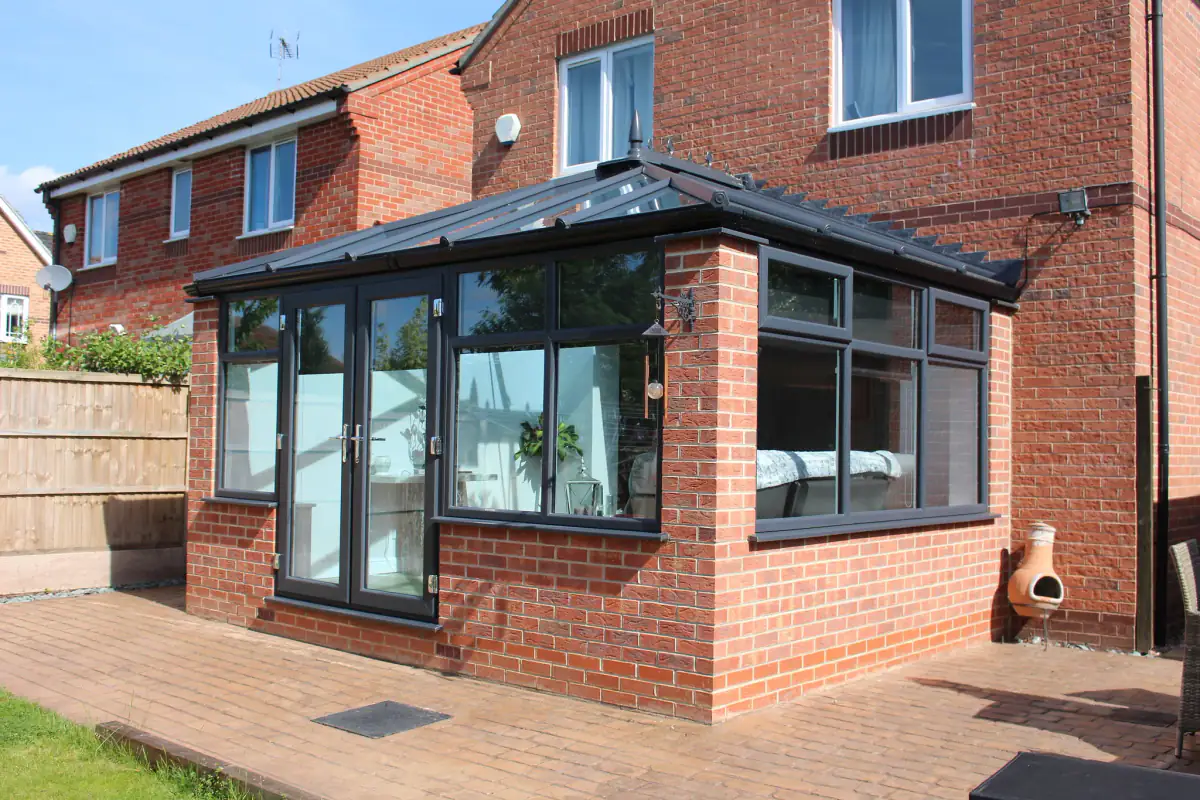
Yes, in that far less heat escapes through the roof, and MoneySavingExpert posters who converted describe a room they can use all year. But walls, windows and the floor still lose heat. One owner said the room is still a couple of degrees colder than the house in winter; another still needed constant heating in winter.
Summer matters too. Difficulty regulating the temperature was the most common conservatory regret among Which? members in April 2026, cited by 24%, and a solid roof removes most of the sun’s heat that pours through glass or polycarbonate. That does not show on a heating bill, but it may save you running a fan or air conditioning, which Which? warns is expensive to run. Our page on the conservatory that is too cold covers the cheaper fixes first.
Will a new roof improve my EPC?
Probably not by itself. RdSAP, the method behind EPCs on existing homes, ignores a conservatory that is separated from the house. Since 6 August 2026 a conservatory whose roof has been replaced must be recorded as an extension, with its insulation recorded only if there is evidence; the net effect on a given rating was not tested in our research.
Even if the rating moved, the value effect looks small. Nationwide found an A or B rating carried a premium of 1.6% over a similar D-rated home, and “little difference” between C, D and E. Keep the roof specification and completion certificate so an assessor can record the insulation.
Is it worth replacing a conservatory roof?
Usually yes for comfort and use, rarely for bill savings alone. If a warm, quiet roof means you would use the room every month of the year, that is the return; the published figures suggest a wait of 15 years or more if you want the money back through lower heating bills.
Our guide to whether a tiled roof is worth it weighs the whole case.

Getting the most from the roof you choose
- Keep the door to the house shut in winter. The Energy Follow-Up Survey found 83% of owners with a separating door keep it shut in winter, mostly to keep heat in the adjoining room.
- Heat it on its own controls. Independent heating with separate temperature and on/off controls keeps the room exempt and lets you heat it only when you use it.
- Ventilate. A solid roof needs airflow to avoid condensation; Ultraframe’s LivinRoof certificate asks for ventilation that keeps relative humidity below 80%.
- Get the whole-roof U-value in writing. When you get quotes, ask each installer for the U-value of the roof as built, including any glazed panels, so you can run the numbers yourself.
Questions people ask
Is a glass conservatory roof warmer than polycarbonate?
It depends on the glass. Ultraframe rates old standard double glazed roof glass at a U-value of 2.8, worse than its 25mm polycarbonate at 1.7, but its performance glass at 1.0 to 1.2, which is better than any polycarbonate it sells. A solid roof at 0.15 beats both by a wide margin.
Do insulated roof panels save as much as a tiled roof?
Probably not. One maker quotes 0.29 at the centre of its panel, about twice the 0.15 a new solid roof must meet, and the existing bars and ridge still lose heat. MoneySavingExpert users who fitted panels reported a more usable room but negligible energy savings.
Should I extend my central heating into the conservatory?
Not if you want it to stay exempt from building regulations in England. The exemption only applies if the house's heating system is not extended into the conservatory, and the Planning Portal describes the requirement as independent heating with its own temperature and on/off controls. Extending the heating means the conservatory has to be treated as an extension.
What is a degree day?
A way of adding up how cold a heating season is. Each day counts the number of degrees its average temperature falls below a base temperature, and the days are added together over the year. Colder areas have more degree days, so the same roof loses more heat there.
Where do the 'over £200 a year' savings figures come from?
Guardian cites modelling by the consultancy AECOM of a standard Victorian 12ft by 12ft conservatory, projecting north from a typical house and heated by electricity, using an energy price forecast. It is manufacturer-commissioned modelling of one scenario, not measured bills, so your saving could be larger or smaller.
Sources
- BRE for DECC: Energy Follow-Up Survey 2011, Report 6 Conservatories
- University of West London: Impact of conservatory as a passive solar design of UK dwellings
- Guardian Building Systems: A warmer winter with a Guardian conservatory roof
- Ultraframe trade: Conservatory market trends
- Conservatory Insulation Solutions: How conservatory insulation can save you money
- Which?: How to keep a conservatory cool (average roof replacement cost)
- Which?: Conservatories, common pitfalls
- Ultraframe: Glass Roof technical guide
- Approved Document L, Volume 1 (2021 edition incorporating 2023 amendments)
- MoneySavingExpert forum: Conservatory roof replacement, is this worth it?
- MoneySavingExpert forum: Replacing conservatory roof
- Planning Portal: Conservatories, building regulations
- BRE: RdSAP Conventions v12.2
- BRE: RdSAP 10 specification
- Nationwide: Energy efficiency ratings have limited impact on owner-occupied house prices
- ASA ruling: Roofsure Ltd
Written by the Conservatory Roof Guide team
We research every figure from named sources: manufacturers' data, Met Office, HM Land Registry, LABC and published UK price guides. How we compare.
Reviewed by Zaib Khan
Founder of Conservatory Roof Guide. His team has handled 9,000+ conservatory roof quote requests from UK homeowners.