The short answer
- Published U-values: 16mm about 1.8 to 2.4, 25mm 1.3 to 1.7, 35mm 1.1 to 1.4. The lower the number, the less heat escapes.
- Structure matters: Brett Martin rates its 16mm triplewall at 2.4 but its 16mm sevenwall at 1.78, and its 35mm XX sheet is no better than its 25mm 7X (both 1.4).
- Tint matters more than thickness in summer: Ultraframe's 25mm clear sheet lets through 63% of the sun's heat, opal 37%, bronze 26% and Solarguard 8%.
- A new polycarbonate roof on a medium conservatory (about 4m x 3.5m) typically costs £2,700 to £5,200 fitted, about £3,900 typical. See polycarbonate roof costs.
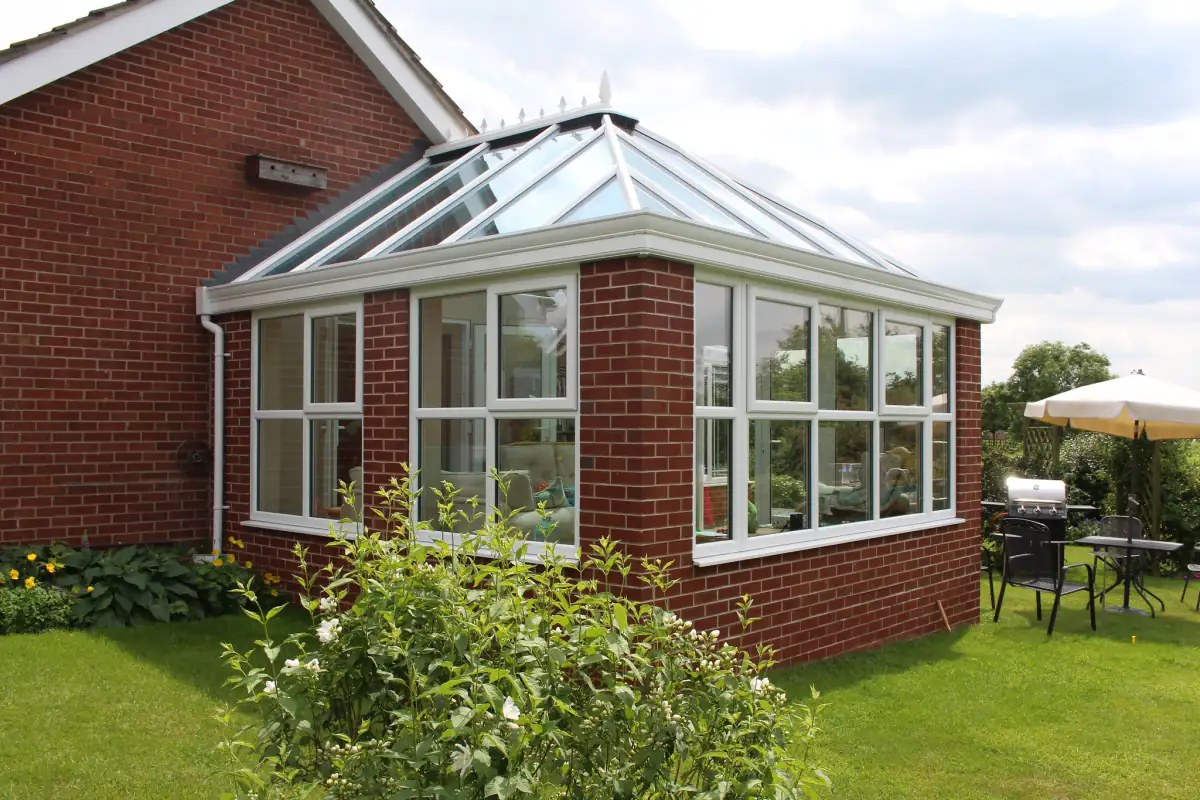
Polycarbonate roof sheet is sold in several thicknesses, most often 10mm, 16mm, 25mm and 35mm, and in general the thicker the sheet, the less heat it lets escape. Published U-values put 16mm at about 1.8 to 2.4 W/m²K, 25mm at 1.3 to 1.7 and 35mm at 1.1 to 1.4. The spread within each thickness is wide, because the number of internal walls matters too. If you are re-roofing in polycarbonate, the real choice is usually between a good 25mm and a good 35mm sheet, and neither comes close to glass or a solid roof for winter comfort.
This guide sets out what the published figures say, what the tint does, how long the sheets are said to last, and what to pin down in a quote.
16mm, 25mm and 35mm polycarbonate compared
A U-value measures how much heat passes through a square metre of roof for each degree of difference between inside and outside. Lower is better. These are the figures published by sheet makers, roof makers and retailers.
| Thickness | Published U-values (W/m²K) | Who says so |
|---|---|---|
| 10mm | 2.4 to 3.2 | Brett Martin (twinwall 3.2, sixwall 2.4); a retailer 2.8 |
| 16mm | 1.78 to 2.4 | Brett Martin (triplewall 2.4, sevenwall 1.78); Exolon 2.0; a retailer 1.9; Superior Conservatory Panels 2.4 |
| 25mm | 1.3 to 1.7 | Exolon HX 1.3; Brett Martin (7X 1.4, fivewall 1.6); a retailer 1.5; Ultraframe 1.7 |
| 32mm | 1.2 to 1.25 | Brett Martin |
| 35mm | 1.08 to 1.4 | Brett Martin (tenwall 1.08, sevenwall 1.2, XX 1.4); a retailer 1.2; Ultraframe 1.3 |
For comparison, Ultraframe rates standard double glazed roof glass at 2.8 and its performance roof glass at 1.0 to 1.2. Insulated aluminium panels are quoted at 0.29 at the centre of the panel, and a new solid roof in England must reach 0.15 under Approved Document L.
Three things stand out:
- Structure can matter more than thickness. Brett Martin’s 16mm sevenwall (1.78) is far better than its 16mm triplewall (2.4), and its 35mm XX sheet (1.4) is no better than its 25mm 7X (1.4). Ask for the U-value of the exact sheet being quoted, not a generic figure for the thickness.
- The step from 25mm to 35mm is modest. On Ultraframe’s figures it improves the U-value by just under a quarter (1.7 to 1.3). Switching to a solid roof at 0.15 cuts it by around 90%.
- Sheet figures are for the sheet alone. They leave out the glazing bars and ridge, and ExpertSure puts polycarbonate roofs at 1.8 to 3.0 in practice.
Thicker sheet also lets through less light. Brett Martin’s clear sheet falls from 82% light transmission (10mm twinwall) to 63% (35mm sevenwall), and Ultraframe’s clear from 65% at 25mm to 51% at 35mm. Weight is not a concern at any thickness: Brett Martin’s sheets run from 1.7kg per m² (10mm twinwall) to 3.9kg (35mm sevenwall).
What does a lower U-value mean for your heating?
Multiply a U-value by 24 hours and you get the heat lost through one square metre of roof for each “degree day”, the unit used to add up how cold a whole winter is. The table shows the result per square metre for every 1,000 degree days.
| Sheet | U-value | Heat lost per m² per 1,000 degree days |
|---|---|---|
| 16mm polycarbonate | 1.78 to 2.4 | 43 to 58 kWh |
| 25mm polycarbonate | 1.3 to 1.7 | 31 to 41 kWh |
| 35mm polycarbonate | 1.08 to 1.4 | 26 to 34 kWh |
| Solid roof at 0.15 | 0.15 | 3.6 kWh |
Multiply by your roof area and the degree days where you live and you have the heat that escapes through the roof in a year. Our heat loss calculator does this sum with Met Office degree days for your region and your fuel price.
This only turns into money if you heat the room. The government’s Energy Follow-Up Survey found about 77% of conservatories had some form of heating, but 20% of those were never heated in winter. If yours sits unheated behind a closed door, a thicker sheet changes comfort more than bills. Our guide to whether a new roof saves money goes through the sums.
Clear, opal, bronze or Solarguard: the tint matters too
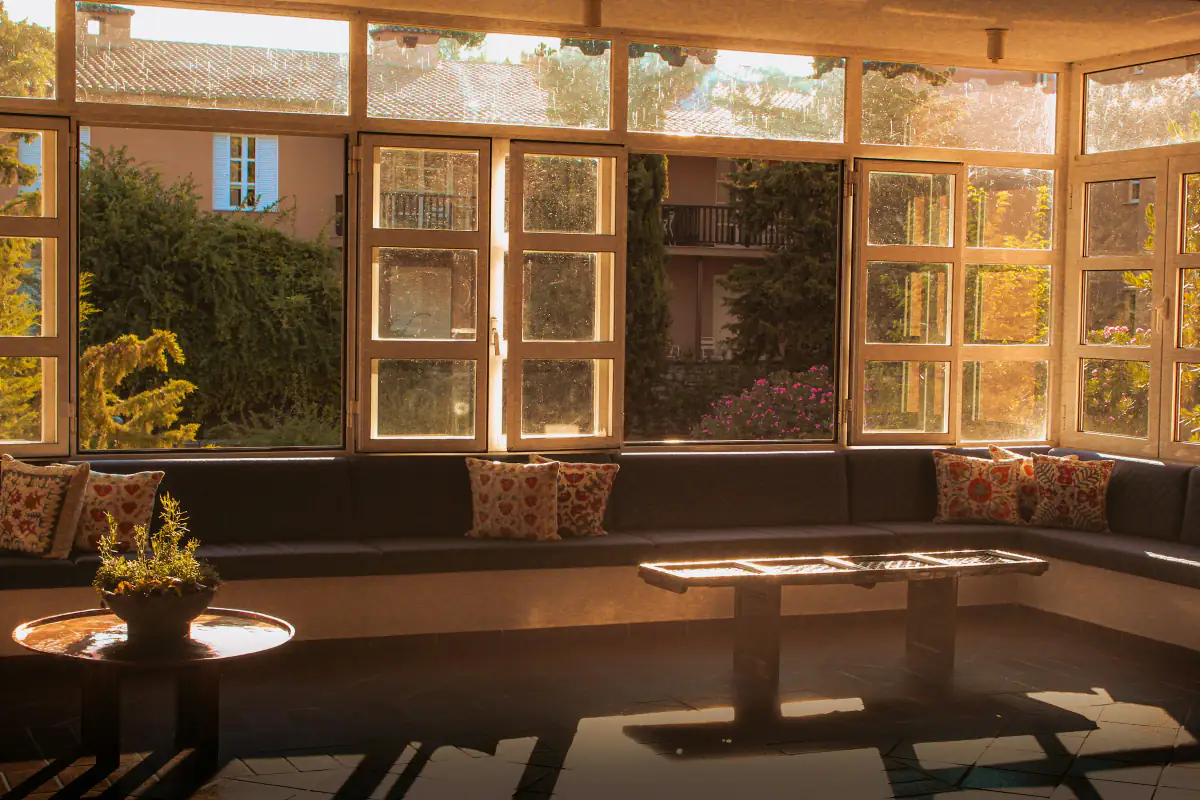
The U-value describes heat escaping in winter. Solar transmission describes how much of the sun’s heat comes in, which is what makes a conservatory overheat in summer. Ultraframe publishes both, with light transmission, for its sheets.
| Tint | 25mm: light let through | 25mm: solar heat let through | 35mm: light let through | 35mm: solar heat let through |
|---|---|---|---|---|
| Clear | 65% | 63% | 51% | 55% |
| Opal | 31% | 37% | 29% | 35% |
| Bronze | 24% | 26% | 11% | 14% |
| Solarguard | 5% | 8% | 8% | 8% |
On these figures, the tint changes summer heat gain far more than the step from 25mm to 35mm does. Clear 35mm still lets in about half as much solar heat again as 25mm opal (55% against 37%). The catch is that the tints that block the most heat also block the most daylight.
Sheet makers sell heat-reflecting versions too. Brett Martin says its Marlon ST Solar Control sheet “reduces temperatures by up to 13 degrees C” compared with clear sheet, and Exolon markets an opal sheet called IQ-Relax as “more light, less heat”. These are makers’ claims without published test conditions.
Ultraframe’s advice for roof glass is to choose high light transmission for north or east facing rooms and low light, high solar rejection for south or west facing ones, and the Glass and Glazing Federation gives similar advice. The same logic is worth applying to sheet tint: a darker or heat-reflecting sheet for a south-facing room that bakes, a clearer one for a shaded room.
Is thicker polycarbonate quieter in the rain?
We could not find any independent measurements of rain noise on polycarbonate of any thickness, so any claim that one thickness is much quieter than another is unproven. Which? says polycarbonate roofs can be noisier than glass, particularly in rain, and ExpertSure calls rain noise “the most-cited complaint” about polycarbonate.
If noise is your main complaint, thickness alone is not a proven fix. Homeowners who replaced polycarbonate with an insulated solid roof report much less rain noise, and Which? rates glass as quieter than polycarbonate. See our page on the noisy conservatory roof for the options.
How much is a new polycarbonate conservatory roof?
A new polycarbonate roof on a medium conservatory (about 4m x 3.5m) typically costs £2,700 to £5,200 fitted, with about £3,900 typical; installers usually quote including VAT, but check. The Federation of Master Builders puts polycarbonate at £2,000 to £4,000, the cheapest roof material, and MyJobQuote says a small to medium job can often be finished in a single day.
The sheet itself is a small part of that. One online retailer listed a 2.1m x 2m sheet of 25mm opal at £125.43 including VAT in September 2026, with 35mm opal from £60.67 for its smallest size. Most of a fitted price is labour, bars, caps, tapes, access and disposal. None of the price guides we reviewed published a fitted price difference between 25mm and 35mm, so ask for both to be quoted if you are undecided. Our polycarbonate roof cost page breaks the price down by size and style.
Which? describes polycarbonate as potentially “a false economy” because of noise and temperature control. It is the cheapest way to fix a leaking or discoloured roof, not a way to make the room comfortable all year.
How long does each thickness last?
Published claims run from about 10 to 30 years, with thicker multiwall sheet generally given the longer lives. Every figure comes from people selling roofs, sheets or price guides, and we found no independent study, so the guarantee is a better guide than any of them. The claims we found:
- A sheet retailer (WholesalePOS): 20 to 25 years for 10mm twin-wall and 25 to 30 years for 16mm to 25mm multiwall.
- Another retailer (Clear Amber): an estimated lifespan of “over 20 years”.
- ConservatoryLand (an installer): 10 to 20 years.
- ExpertSure (a review site): 10 to 15 years before it discolours, noting that clear sheets yellow over time.
- Insulation Superstore and The Eco Experts: as little as, or around, 10 years.
We found no independent study, so treat 10 to 20 years as a working range and look hard at the guarantee. Exolon gives 10 years on weathering, hail resistance and UV stability, and Ultraframe’s guide shows a 10-year guarantee for its 25mm sheet. Brett Martin offers a “limited warranty” without a published length, and ExpertSure says some products carry only five years. Our guide to how long a conservatory roof lasts compares polycarbonate with glass and tiled roofs.
Can a thicker sheet go into your existing glazing bars?
Often, but check first. Re-sheeting keeps the existing glazing bars, caps and rafters, so the new sheet has to suit them, and old bars or clips may need replacing anyway. Ask the installer to confirm that your bars take the thickness you want. In outline, the job goes like this:
- The top caps and end caps come off the glazing bars.
- The old sheets come out, and the bars, rafters and seals are inspected.
- New sheets go in with the flutes running downhill, solid aluminium tape sealing the top edge, breather tape on the bottom edge so moisture can escape, and end closures. Brett Martin recommends the same tapes to keep moisture and dust out of the channels.
- The caps go back on and screw holes are sealed.
Ultraframe notes that top cap clips “are likely to be damaged” when caps are removed and will need replacing. In one supplier case study the timber rafters were kept but the glazing bars were replaced as a precaution because they were at least 10 years old. If the bars are old or damaged, ask whether new bars are in the price.
A like-for-like translucent roof is normally exempt from building regulations in England, as long as the conservatory still meets the exemption afterwards: ground level, floor area not over 30m², compliant safety glazing, separated from the house by external-quality doors or windows, and not heated from the house system. Whether re-sheeting needs any notification was not confirmed in our research, so ask your council’s building control if in doubt. Our building regulations guide covers the detail.
When polycarbonate is the wrong choice
Thicker sheet narrows the gap to glass but does not close the gap to an insulated roof. If comfort is the goal, compare the alternatives on the same medium conservatory:
| Roof | U-value | Typical fitted price, medium conservatory |
|---|---|---|
| New polycarbonate (25mm to 35mm) | 1.1 to 1.7 | £2,700 to £5,200 |
| Insulated roof panels or lining | 0.29 at centre of panel | £1,800 to £4,600 |
| Performance glass | 1.0 to 1.2 | £3,500 to £7,000 |
| Lightweight tiled roof | 0.15 or better | £7,400 to £12,100 |
Moving from polycarbonate to glass is rarely a sheet swap. One installer says glass is much heavier than polycarbonate and that most such projects need an entirely new roof designed for glass, and LABC notes that frames built for polycarbonate may only be reinforced for that lighter load. Our glass vs polycarbonate comparison covers that choice.
What to ask for in a polycarbonate quote
When you get quotes, ask each installer to state in writing:
- The sheet thickness, structure (for example fivewall or sevenwall) and brand. Brands include Marlon ST from Brett Martin, Exolon multi UV (Exolon says “Makrolon is now Exolon”) and retailer own brands.
- The U-value for that exact sheet, and the light and solar transmission for the tint.
- Whether the glazing bars, caps, clips and end closures are new or reused.
- Which tapes are used at the top and bottom of the sheets.
- What the sheet guarantee covers (weathering, hail, discolouration, light loss) and for how long.
- Whether removal, disposal and safe access (not standing on the roof) are included.
Questions people ask
Is 16mm polycarbonate good enough for a conservatory roof?
It keeps the rain out, but it loses more heat than thicker sheet. Published U-values for 16mm run from about 1.8 to 2.4 depending on the internal structure, against 1.3 to 1.7 for 25mm and 1.1 to 1.4 for 35mm. One online retailer describes 16mm as the most popular thickness for conservatories, but if you heat the room or use it in winter, a thicker multiwall sheet loses less heat.
What is the U-value of 25mm polycarbonate?
It depends on the sheet. Ultraframe rates its 25mm sheet at 1.7 W/m²K, Brett Martin gives 1.6 for its 25mm fivewall and 1.4 for its 7X structure, and Exolon gives 1.3 for its 25mm HX sheet. Ask for the figure for the exact sheet named in your quote.
Does opal polycarbonate keep a conservatory cooler?
It lets in less of the sun's heat than clear sheet. On Ultraframe's figures, 25mm opal transmits 37% of solar heat against 63% for clear, and its Solarguard tint 8%. The trade-off is less daylight: opal lets through 31% of visible light against 65% for clear.
Do I need building regulations to replace polycarbonate with new polycarbonate?
Usually not in England, provided the conservatory still meets the exemption afterwards: ground level, floor area not over 30m², compliant safety glazing, and separated from the house and its heating. Swapping to a solid or insulated panel roof is different and needs a building regulations application.
Can I walk on a polycarbonate roof to clean it?
No. Installers advise against walking on polycarbonate, and Ultraframe says it is not safe to stand directly on a conservatory roof. It says special ladders can be hired for maintenance access instead.
Sources
- Brett Martin: Marlon ST multiwall polycarbonate brochure
- Brett Martin: Marlon ST Solar Control
- Exolon Group: multi UV multiwall polycarbonate
- Ultraframe: Glass Roof technical guide (glass and polycarbonate U-values, light and solar transmission)
- WholesalePOS: Polycarbonate roofing sheets complete guide 2026
- Superior Conservatory Panels: Polycarbonate vs aluminium roof
- Clear Amber: Axiome 25mm opal multiwall polycarbonate sheet
- Insulation Superstore: Insulating a conservatory
- ExpertSure: Tiled vs glass vs polycarbonate roof
- Approved Document L, Volume 1 (2021 edition incorporating 2023 amendments)
- Building Regulations 2010, regulation 9 (exempt work)
- Federation of Master Builders: Conservatory roof replacement costs
- MyJobQuote: Conservatory roof replacement costs
- Which?: Conservatories, common pitfalls
- HTG / insu: Replacement polycarbonate conservatory roof
- BRE for DECC: Energy Follow-Up Survey 2011, Report 6 Conservatories
Written by the Conservatory Roof Guide team
We research every figure from named sources: manufacturers' data, Met Office, HM Land Registry, LABC and published UK price guides. How we compare.
Reviewed by Zaib Khan
Founder of Conservatory Roof Guide. His team has handled 9,000+ conservatory roof quote requests from UK homeowners.